Event-Driven Architecture & Distributed Messaging: The Complete 2026 Blueprint
Event Sourcing, CQRS, Idempotency, Dead-Letter Queues, and Kafka vs RabbitMQ Trade-Offs
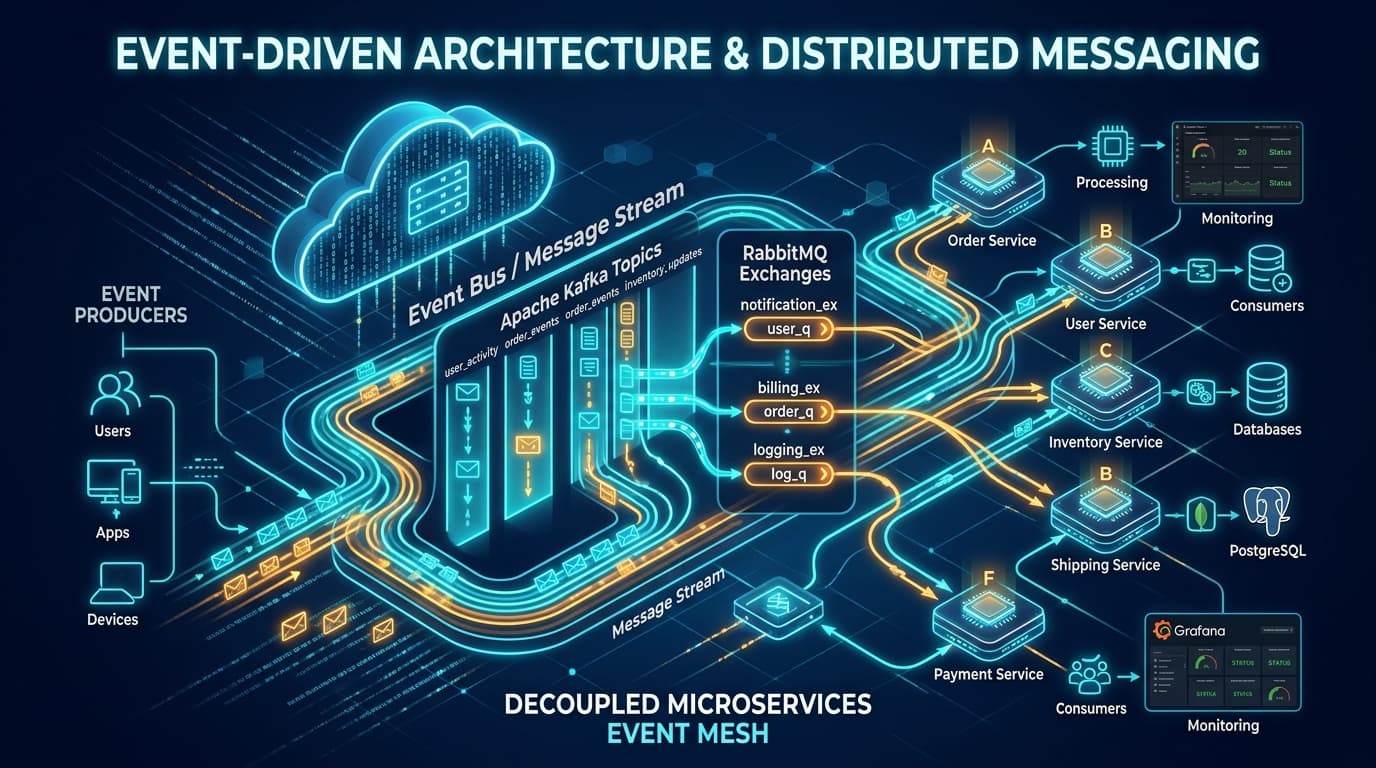
What You Must Master to Clear This Track
- Dual-write bugs (updating a database then publishing an event) MUST be solved using the Transactional Outbox Pattern.
- Distributed message brokers deliver messages with at-least-once semantics; consumers MUST be designed to be strictly idempotent.
- Kafka is an append-only distributed commit log optimized for high-throughput replayable event streams; RabbitMQ is a smart broker with complex routing exchanges.
- CQRS (Command Query Responsibility Segregation) decouples write-optimized relational models from read-optimized denormalized view stores.
- Dead Letter Queues (DLQ) paired with automated poison-pill retry strategies prevent consumer lag from cascading across downstream systems.
Step-by-Step Study Plan
Follow this sequential roadmap designed to take you from core foundations to advanced architecture and mock interviews.
Broker Mechanics & The Outbox Pattern
Understand message broker topologies, delivery semantics, and atomicity across databases and messaging systems.
- •Implement the Transactional Outbox pattern with Debezium Change Data Capture (CDC).
- •Differentiate At-Most-Once, At-Least-Once, and Effectively Exactly-Once delivery guarantees.
- •Design unique idempotency key validation tables for consumer services.
- •Never publish to Kafka inside an active SQL transaction without an outbox table.
- •Use PostgreSQL LISTEN/NOTIFY or Debezium to stream outbox records to Kafka.
Immutable State Streams & Read Projections
Replace mutable database rows with append-only event logs, snapshots, and Elasticsearch/Redis read models.
- •Model domain aggregates using Event Sourcing: OrderCreated, OrderPaid, OrderShipped.
- •Implement periodic snapshotting to speed up aggregate hydration for long-lived entities.
- •Build asynchronous projectors updating NoSQL read models via Kafka consumer groups.
- •Enforce schema evolution rules using Confluent Schema Registry or Avro/Protobuf.
- •Design compensation transactions for business rollbacks (Saga orchestrator pattern).
Dead Letter Queues & Backpressure
Handling poison pills, backpressure, consumer rebalances, and partition skew in production.
- •Build exponential backoff retry topics with a terminal Dead Letter Queue (DLQ).
- •Analyze consumer lag metrics using Prometheus and Grafana dashboards.
- •Implement partition key hashing strategies to avoid hot partitions.
- •Avoid using random UUIDs as Kafka partition keys when strict in-order processing is required per entity.
- •Test partition rebalances under sustained throughput to ensure zero message loss.
1. Eliminating Dual-Write Bugs: The Transactional Outbox Pattern
In distributed microservices, attempting to update an order in SQL and then publish an OrderCreated event to Kafka is fundamentally broken: if the broker is unreachable, the event is lost; if the DB fails after publish, ghost events exist.
The business entity update and an outbox record are committed together in the same atomic database transaction.
An asynchronous relay process (like Debezium reading the Postgres WAL log) reads outbox records and reliably forwards them to Kafka.
-- Outbox Table Definition
CREATE TABLE outbox_events (
    id UUID PRIMARY KEY,
    aggregate_type VARCHAR(64) NOT NULL,
    aggregate_id VARCHAR(64) NOT NULL,
    event_type VARCHAR(128) NOT NULL,
    payload JSONB NOT NULL,
    created_at TIMESTAMP WITH TIME ZONE DEFAULT NOW()
);

-- Atomic Business Operation in Single Transaction
BEGIN;
UPDATE orders SET status = 'COMPLETED' WHERE id = 'ord_123';
INSERT INTO outbox_events (id, aggregate_type, aggregate_id, event_type, payload)
VALUES (
    gen_random_uuid(),
    'Order',
    'ord_123',
    'OrderCompleted',
    '{"orderId": "ord_123", "total": 149.99, "timestamp": 1715400000}'
);
COMMIT;2. Kafka vs RabbitMQ: Deep Architectural Trade-Offs
Choosing between Kafka and RabbitMQ is one of the most common system design interview questions. Understanding their underlying architecture prevents flawed technical choices.
Pushes messages to consumers, supports complex routing keys and exchange patterns, and deletes messages once acknowledged.
Append-only distributed commit log. Consumers pull data by offset index, allowing multiple independent consumer groups to replay history.
Top Must-Know Interview Questions & Model Answers
Q1: How do you guarantee strictly idempotent message processing in an asynchronous consumer?
- •Unique Message ID Check: Store processed message IDs in a dedicated processed_messages table inside the consumer database transaction.
- •Idempotent Business Logic: Design operations to be naturally idempotent (e.g. UPDATE user SET balance = 500 rather than balance = balance + 100).
- •Optimistic Concurrency Control: Include an entity version number in the event payload (WHERE version = expected_version).
Q2: What is the Difference Between Event Sourcing and CQRS?
- •Event Sourcing: You don't store the current state of a bank account ($500); you store every transaction (+100, -50, +450) and compute current state by replaying events.
- •CQRS: Commands (Writes) go to an optimized write database, which emits events to update denormalized Read Models (e.g. ElasticSearch, Redis) optimized for queries.
- •Synergy: Event Sourcing naturally pairs with CQRS because domain events provide the exact data feed needed to update external read projections.
Recommended Practice Quizzes on QuizCluster
Test your retention and prepare for timed live coding and MCQ technical screening rounds:
Apache Kafka & Event Streaming Quiz
Test consumer group rebalancing, partition leadership, log compaction, and ISR replication.
High-Level System Design Quiz
Test distributed transactions, Saga patterns, caching layers, and asynchronous event pipelines.
Frequently Asked Questions
Why can't message brokers guarantee physical exactly-once delivery across network partitions?
Due to the Two Generals' Problem: if a network failure occurs right after a message is processed but before the consumer acknowledgment reaches the broker, the broker must re-deliver the message to ensure it isn't lost. Thus, exactly-once is achieved logically via at-least-once delivery plus idempotent consumer processing.
What is an event poison pill and how should systems handle it?
A poison pill is a malformed message that consistently causes the consumer to throw an unhandled exception and crash. Systems must route poison pills to a Dead Letter Queue (DLQ) after a defined retry threshold (e.g., 3 retries with exponential backoff) so other messages can continue processing.