PostgreSQL Internals & Query Optimization: Deep-Dive 2026 DBA & SDE Guide
MVCC Storage Mechanics, B-Tree vs GIN/BRIN Indexing, EXPLAIN ANALYZE, and Vacuum Tuning
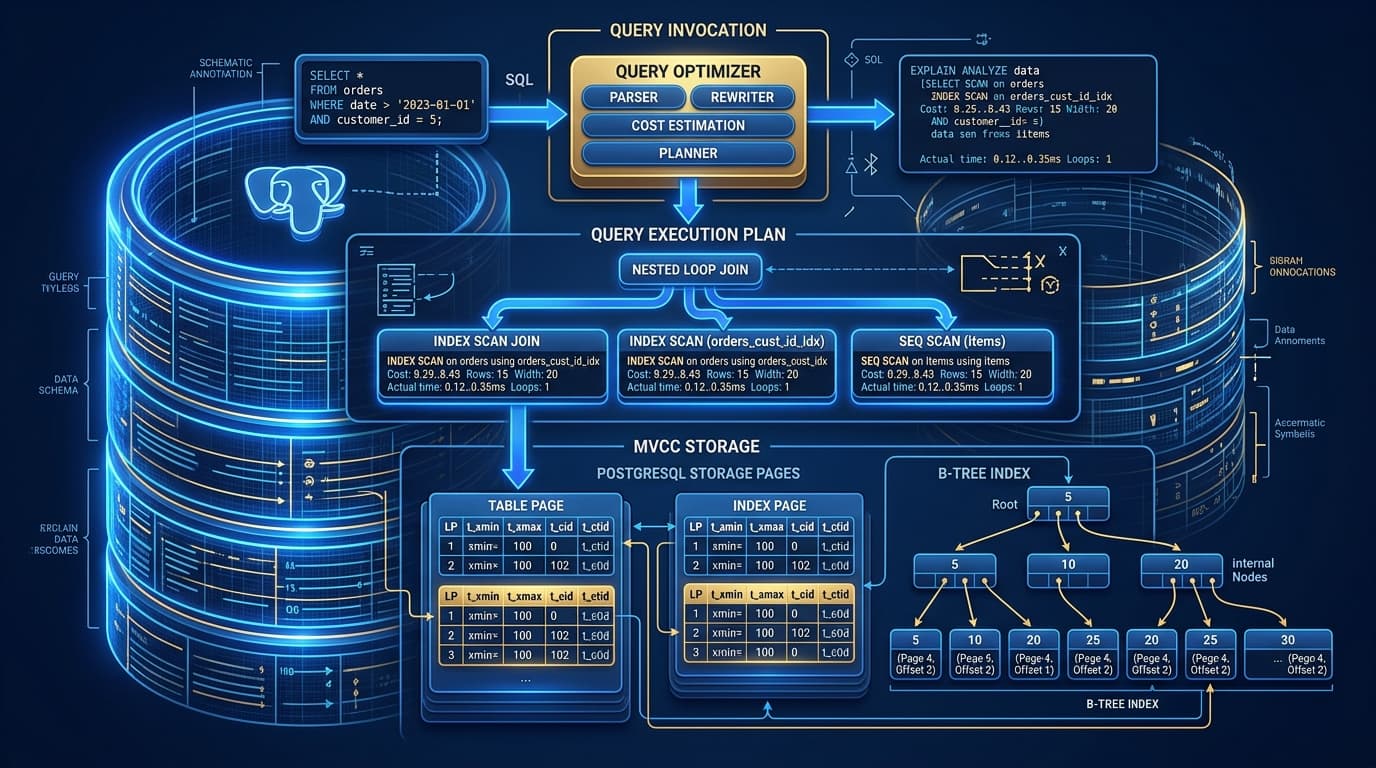
What You Must Master to Clear This Track
- Understand MVCC tuple headers (xmin, xmax) and why UPDATE in Postgres is physically an INSERT + DELETE.
- Tune autovacuum parameters (autovacuum_vacuum_scale_factor) to prevent table bloat and transaction ID wraparound.
- Select the right index engine: B-Tree for equality/ranges, GIN for JSONB and arrays, BRIN for sorted time-series data.
- Deconstruct EXPLAIN (ANALYZE, BUFFERS) to identify Sequential Scans, Sort Spills to Disk, and Buffer Cache misses.
- Deploy connection poolers (PgBouncer in transaction mode) to eliminate process-per-connection memory bottlenecks.
Step-by-Step Study Plan
Follow this sequential roadmap designed to take you from core foundations to advanced architecture and mock interviews.
MVCC, Pages & WAL Mechanics
Understand 8KB page layout, tuple visibility, Write-Ahead Logging (WAL), and checkpointing.
- •Examine page headers, line pointers, and tuple headers (xmin, xmax, t_ctid).
- •Analyze transaction isolation anomalies: Dirty Read, Non-repeatable Read, Phantom Read, and Serialization Anomaly.
- •Tune shared_buffers, work_mem, and maintenance_work_mem settings.
- •Use the pageinspect extension to inspect physical disk layout of tables and indexes.
- •Simulate concurrent transactions under READ COMMITTED vs REPEATABLE READ.
B-Tree, GIN, BRIN & Execution Plans
Deep dive into cost-based query optimizer, join algorithms (Nested Loop, Hash Join, Merge Join), and indexes.
- •Master EXPLAIN (ANALYZE, BUFFERS, VERBOSE) interpreting Cost, Rows, Width, and Shared Hit blocks.
- •Compare B-Tree vs GIN index creation speed, index size on disk, and lookup performance on JSONB columns.
- •Use Partial Indexes (WHERE deleted_at IS NULL) and Covering Indexes (INCLUDE clauses).
- •Create composite indexes matching column selectivity and query equality-then-range ordering.
- •Avoid using functions on indexed columns in WHERE clauses without expression indexes.
Vacuum Tuning, Partitioning & Connection Pooling
Configuring autovacuum workers, table partitioning (range, hash), and PgBouncer connection pooling.
- •Set up declarative table partitioning on large tables (>50GB) by timestamp ranges.
- •Configure PgBouncer in transaction pooling mode to scale to 10,000+ client connections.
- •Tune autovacuum_vacuum_cost_limit to prevent I/O saturation during background vacuuming.
- •Monitor pg_stat_activity and pg_stat_user_tables for dead tuple percentage and long-running queries.
- •Set lock_timeout and statement_timeout to avoid lock queue starvation during migrations.
1. Multi-Version Concurrency Control (MVCC) & Table Bloat
In PostgreSQL, readers never block writers and writers never block readers. This concurrency is achieved through Multi-Version Concurrency Control (MVCC), where rows are never modified in place.
Each row tuple contains metadata columns: xmin (transaction that inserted the row) and xmax (transaction that updated or deleted the row).
Dead tuples (superseded by newer updates) occupy space until VACUUM scans table pages, marks space as reusable in the Free Space Map (FSM), and updates visibility maps.
SELECT
    relname AS table_name,
    n_live_tup AS live_tuples,
    n_dead_tup AS dead_tuples,
    round(n_dead_tup * 100.0 / nullif(n_live_tup + n_dead_tup, 0), 2) AS dead_tuple_percent,
    last_vacuum,
    last_autovacuum
FROM pg_stat_user_tables
ORDER BY dead_tuples DESC
LIMIT 10;

-- Per-table aggressive autovacuum tuning for high-write tables
ALTER TABLE high_velocity_orders SET (
    autovacuum_vacuum_scale_factor = 0.05,
    autovacuum_vacuum_threshold = 500
);2. Indexing Engines: When to Choose B-Tree, GIN, or BRIN
Choosing the wrong index engine can result in indexes that are 10x larger than necessary or completely ignored by the query planner.
The default. Ideal for unique lookups, range queries (<, >, BETWEEN), and sorting (ORDER BY) on scalar columns.
Essential for composite values: JSONB document containment (@>), array elements, and full-text search tsvector queries.
Tiny footprint index (kilobytes instead of gigabytes) for enormous tables where data is naturally physically sorted on disk (like sequential timestamps).
Top Must-Know Interview Questions & Model Answers
Q1: How do you analyze a slow query using EXPLAIN (ANALYZE, BUFFERS)?
- •Seq Scan vs Index Scan: A sequential scan on a table with 10M rows indicates a missing or unselected index.
- •Shared Hit vs Shared Read: 'Shared Hit' means data came from RAM shared_buffers; 'Shared Read' means physical disk I/O was required.
- •Row Estimation Errors: If estimated rows = 1 and actual rows = 100,000, table statistics are stale. Run ANALYZE on the table.
- •Sort / Hash Spills: Look for 'Sort Method: external merge Disk'. This indicates work_mem is too low, forcing the query to sort on slow disk.
Q2: Why does PostgreSQL create a separate process per connection, and why is PgBouncer essential?
- •Process Overhead: At 1,000 direct connections, 5-10GB of RAM is wasted on connection state alone, causing severe CPU cache thrashing during context switches.
- •Connection Pooling: PgBouncer in Transaction Pooling mode allows 5,000 frontend web requests to share 50-100 active PostgreSQL backend connections.
- •Performance Impact: Keeps active database processes near the physical CPU core count (e.g. 16-64), maximizing CPU throughput and cache locality.
Recommended Practice Quizzes on QuizCluster
Test your retention and prepare for timed live coding and MCQ technical screening rounds:
SQL & Relational Database Mastery Quiz
Test indexing mechanics, query joins, window functions, ACID isolation levels, and normalization.
Database System Design Quiz
Test sharding algorithms, replication topologies, write-ahead logs, and distributed consensus.
Frequently Asked Questions
Why does an index sometimes slow down write queries?
Every INSERT, UPDATE, or DELETE on a table requires modifying every index on that table. If a table has 8 indexes, an INSERT produces 9 writes (1 table heap write + 8 index updates), significantly slowing write throughput.
When should I partition a PostgreSQL table?
Partitioning is recommended when a table exceeds 50-100GB or when individual query access patterns naturally isolate by partition key (such as querying only the last 30 days of logs), allowing partition pruning to skip untouched data blocks entirely.