How to Prepare for Microservices Developer Interview: Distributed Architecture & Cloud
End-to-End Guide to Distributed Transactions, Saga Pattern, Kafka, Service Mesh & Resilience
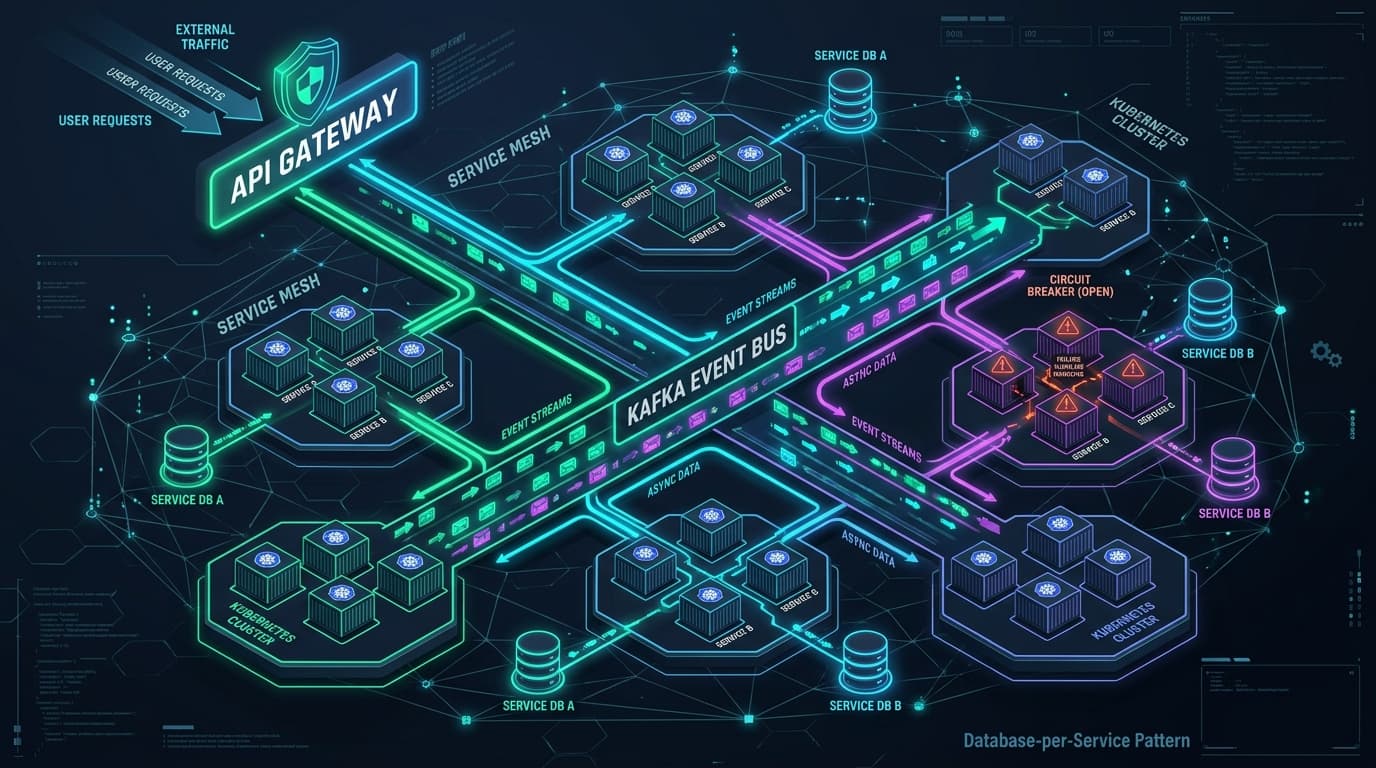
What You Must Master to Clear This Track
- Understand why 2-Phase Commit (2PC) is an anti-pattern in high-scale microservices and how the Saga Pattern (Choreography vs Orchestration) delivers eventual consistency.
- Implement the Transactional Outbox Pattern with Debezium CDC to guarantee zero data loss when writing to databases and publishing to Kafka.
- Master Resiliency Patterns: Circuit Breakers (Resilience4j), Rate Limiters (Token Bucket), Retries with Exponential Backoff + Jitter, and Bulkhead isolation.
- Design zero-trust API Gateways handling SSL termination, JWT validation, rate limiting, and request transformation.
- Explain the 3 pillars of distributed observability: Metrics (Prometheus/Grafana), Distributed Tracing (OpenTelemetry/Jaeger with W3C Trace Context), and Centralized Logging (ELK/Loki).
Step-by-Step Study Plan
Follow this sequential roadmap designed to take you from core foundations to advanced architecture and mock interviews.
Domain-Driven Design & Inter-Service Communication
Bounded Contexts, Database-per-Service, Synchronous (gRPC/HTTP2) vs Asynchronous (Kafka/RabbitMQ) communication models.
- •Decompose monoliths using Domain-Driven Design (Aggregates, Value Objects, Domain Events).
- •Implement Protobuf schemas and high-throughput bidirectional gRPC services.
- •Design idempotency keys for POST/PUT API requests to prevent double-charging.
- •Never share a single database instance between two separate domain microservices.
- •Always design APIs with backwards compatibility and API versioning strategies.
Saga Pattern, Outbox Pattern & Kafka Event Streaming
Choreography vs Orchestration Sagas, Compensating transactions, Kafka consumer groups, partition keys, and offset commits.
- •Implement an Orchestrated Saga with Temporal or Camunda for a multi-step Order-Payment-Inventory workflow.
- •Prevent dual-write race conditions using the Transactional Outbox Pattern.
- •Configure Kafka topic partitions, replication factors, and dead-letter queues (DLQ).
- •Understand Kafka delivery guarantees: At-most-once, At-least-once, and Effectively-once semantics (Kafka transactions).
Fault Tolerance, Service Mesh & Kubernetes Deployments
Circuit Breakers, Bulkhead pattern, Istio Service Mesh, OpenTelemetry distributed tracing, and Blue/Green & Canary rollouts.
- •Configure Resilience4j circuit breaker state transitions: CLOSED -> OPEN -> HALF-OPEN.
- •Inject traceparent headers across microservices for end-to-end distributed latency tracing.
- •Deploy containerized microservices to Kubernetes with Ingress, Service, ConfigMap, and Horizontal Pod Autoscalers (HPA).
- •Always test fallback methods and graceful degradation when upstream dependencies fail.
1. Distributed Transactions & The Saga Pattern
Because each microservice maintains its own private database, traditional ACID transactions cannot span multiple services. The Saga Pattern solves this through compensating transactions.
Decentralized event flow. Service A publishes OrderCreated; Service B listens, charges payment, and publishes PaymentSuccess; Service C reserves inventory. Best for simple 2-3 step workflows.
A centralized Saga Orchestrator coordinates commands: instructs Payment Service -> awaits response -> instructs Inventory Service. If Inventory fails, the orchestrator triggers a compensating refund command.
You cannot rollback committed database transactions in microservices; you must execute a compensating forward action (e.g. Credit Card Refund, Release Reserved Stock).
@Service
public class OrderService {

    @Autowired
    private OrderRepository orderRepository;

    @Autowired
    private OutboxRepository outboxRepository;

    @Transactional // Guarantees both DB write & Outbox event save in ONE atomic commit
    public Order createOrder(OrderRequest request) {
        Order order = new Order(request.getCustomerId(), request.getItems(), OrderStatus.PENDING);
        Order savedOrder = orderRepository.save(order);

        // Save event to the Outbox table in the SAME database transaction
        OutboxEvent event = new OutboxEvent(
            "Order",
            savedOrder.getId().toString(),
            "OrderCreatedEvent",
            toJson(savedOrder)
        );
        outboxRepository.save(event);

        return savedOrder;
        // A background CDC tool (Debezium) or poller streams Outbox records to Kafka
    }
}2. Fault Tolerance & Resiliency Patterns (Circuit Breakers)
In a microservices topology with hundreds of networked services, network latency, timeouts, and cascading failures are inevitable.
Monitors downstream failure rates. If failure percentage exceeds threshold (e.g. 50% over 20 requests), the circuit trips to OPEN state, instantly failing fast and executing a fallback without hitting the overwhelmed downstream service.
Isolates thread pools and connection pools per downstream dependency, ensuring a slow third-party payment gateway does not consume all Tomcat threads and bring down the entire web server.
When retrying failed network requests, exponential delay alone causes thundering herd spikes. Adding random jitter spreads retry traffic evenly.
3. Event-Driven Architecture with Apache Kafka
Kafka acts as the central nervous system for asynchronous decoupling in modern cloud distributed systems.
Topics are partitioned for horizontal write scale. Records with the same partition key (e.g. customerId) are guaranteed to land in the same partition and be consumed in strict FIFO order.
Multiple consumer instances in a consumer group share topic partitions. If one consumer crashes, Kafka automatically triggers a rebalance and reassigns partitions to surviving workers.
Unprocessable poison pill messages are routed to a DLQ topic after N failed retries, preventing the consumer lag from locking up the main partition.
API Gateway routing, service mesh communication, and asynchronous event streams.
Top Must-Know Interview Questions & Model Answers
Q1: How do you handle Distributed Tracing across 50+ microservices?
- •When a user request enters the API Gateway, a unique 128-bit trace-id is generated.
- •Every downstream microservice reads the traceparent header, creates a child span with its own span-id, records start/end timestamps and error tags, and sends telemetry to an OpenTelemetry Collector exporting to Jaeger/Zipkin.
Q2: What is the difference between Service Discovery (Eureka/Consul) vs Kubernetes CoreDNS?
- •In client-side discovery, the microservice queries Eureka server for healthy IP instances and performs load balancing internally (e.g. Spring Cloud LoadBalancer).
- •In cloud-native K8s, each Service gets a static DNS name (e.g. order-service.default.svc.cluster.local) and kube-proxy automatically distributes traffic to healthy backend Pod endpoints.
Q3: How do you prevent the 'Dual-Write' problem when saving to database and publishing to message queue?
- •Dual write happens when you update DB and then call kafkaProducer.send(). If the network fails between DB commit and Kafka send, the message is lost forever.
- •Outbox pattern writes the business entity and an Outbox event row in the exact same local ACID transaction. A dedicated CDC connector streams outbox events to Kafka with zero loss.
Recommended Practice Quizzes on QuizCluster
Test your retention and prepare for timed live coding and MCQ technical screening rounds:
Frequently Asked Questions
When should an organization migrate from Monolith to Microservices?
Only when team scaling bottlenecks, independent deployment requirements, and domain boundaries justify the operational complexity of distributed systems. Premature microservices adoption is a major source of architectural failure.
Should microservices communicate via REST or gRPC?
Use REST / JSON for external public client APIs and web browsers. Use gRPC (HTTP/2 with Protobuf binary serialization) for internal high-throughput service-to-service communication due to 5x-10x performance gains.