GraphQL API Architecture & Enterprise Federation: 2026 Interview Guide
Solving N+1 Queries, Subgraph Federation, DataLoader Batching, and High-Throughput Caching
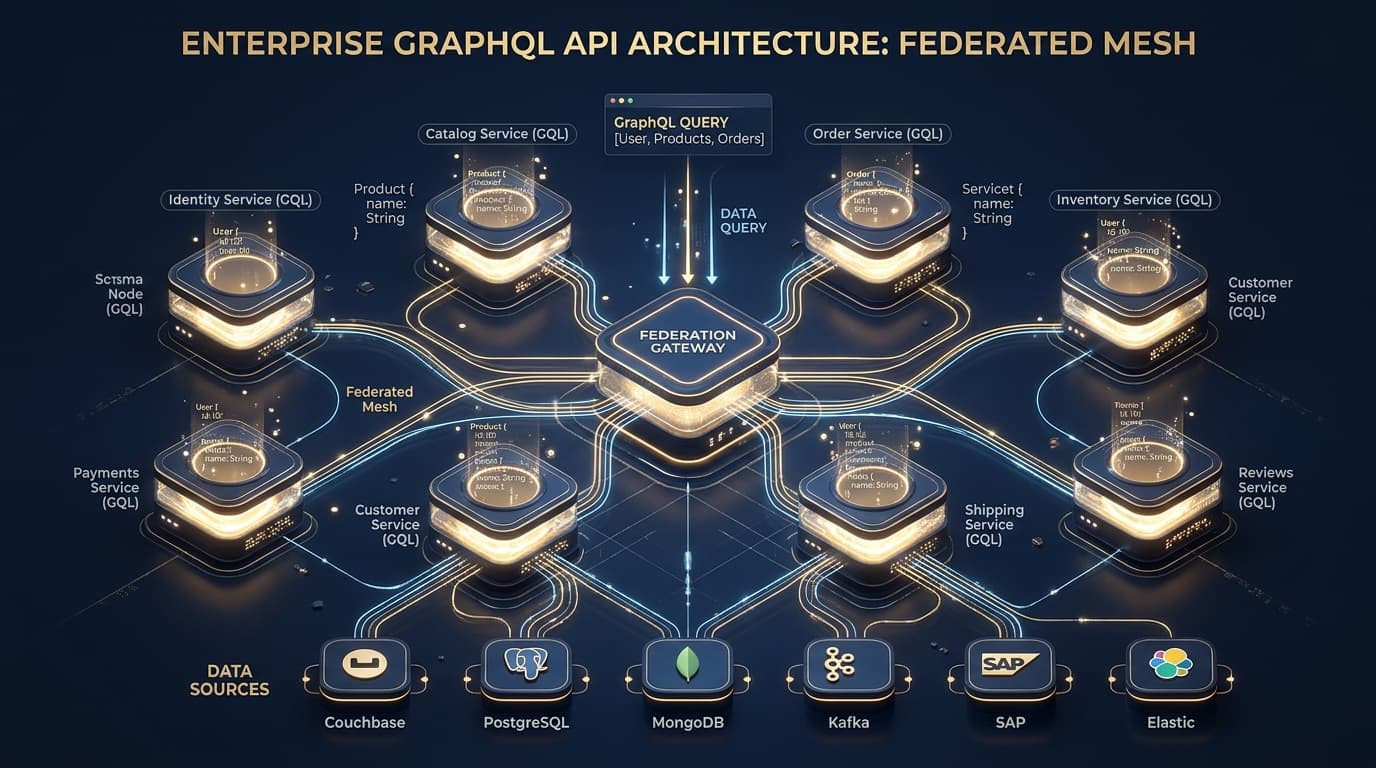
What You Must Master to Clear This Track
- Always mitigate the N+1 query problem using DataLoader batching and per-request memoization.
- Design schemas from the client consumption perspective rather than directly mirroring database tables.
- Use Apollo Federation 2 with @key, @shareable, and @external directives to compose decoupled subgraphs.
- Implement persisted queries and query depth/complexity analysis to protect GraphQL servers from DoS attacks.
- Combine CDN edge caching with Redis cache directives using @cacheControl for high-traffic read queries.
Step-by-Step Study Plan
Follow this sequential roadmap designed to take you from core foundations to advanced architecture and mock interviews.
GraphQL Core Spec & Resolvers
Master AST query parsing, schema definition language (SDL), resolver execution flows, and field selection.
- •Model schemas using strict scalar types, enums, unions, and interface abstractions.
- •Implement custom input types and mutation payload standards with error unions.
- •Profile resolver tree traversal and understand breadth-first resolution order.
- •Avoid exposing raw internal DB IDs; use base64 encoded global node IDs (Relay specification).
- •Always return distinct UserResult unions (Success | ValidationError | Unauthorized) on mutations.
DataLoader, Batching & Query Protection
Solve the N+1 query problem, configure batch loading, query complexity limits, and rate limiting.
- •Implement DataLoader per-request instantiation to prevent cross-request memory leaks.
- •Configure graphql-cost-analysis to reject queries with depth > 6 or cost > 1000 points.
- •Deploy Automatic Persisted Queries (APQ) to minimize payload size and enable CDN caching.
- •Benchmark SQL queries before and after DataLoader batching using EXPLAIN ANALYZE.
- •Add token bucket rate limiting on top-level query operations based on client API keys.
Apollo Federation & Distributed Gateways
Build multi-team federated microservices with federated gateways, subgraph stitching, and observability.
- •Decompose monolith schema into Users, Orders, and Inventory subgraphs.
- •Define entity ownership with @key(fields: "id") and reference resolution.
- •Set up distributed tracing across gateway and subgraphs with OpenTelemetry.
- •Run schema composition checks in CI/CD pipeline using Rover CLI before deploying subgraphs.
- •Simulate subgraph downtime to verify gateway circuit breakers and partial query fallback.
1. Solving the Infamous N+1 Query Problem with DataLoader
In naive GraphQL resolver implementations, resolving a list of 50 users where each user resolves their orders triggers 1 initial query plus 50 separate order queries — destroying database performance.
DataLoader collects all individual load(id) calls issued during the same Node.js event loop tick and dispatches a single batch query (WHERE id IN (...)).
DataLoader caches promise results for identical keys within the lifecycle of a single HTTP request, preventing duplicate reads while preserving data freshness.
import DataLoader from 'dataloader';

// Create factory to ensure fresh cache per HTTP request
export function createOrderLoader(db: Database) {
  return new DataLoader<string, Order[]>(async (userIds) => {
    // Single query replaces N individual queries
    const orders = await db.query(
      'SELECT * FROM orders WHERE user_id = ANY($1)',
      [userIds]
    );

    // Group orders by userId and map to original key array order
    const orderMap = new Map<string, Order[]>();
    orders.forEach(order => {
      const list = orderMap.get(order.userId) || [];
      list.push(order);
      orderMap.set(order.userId, list);
    });

    return userIds.map(id => orderMap.get(id) || []);
  });
}- Never instantiate DataLoader globally; always instantiate it inside GraphQL context creation so cached data does not bleed across different users.
- For massive batch lists exceeding 1000 items, configure the maxBatchSize option to prevent SQL query parameter limit exhaustion.
- Returning fewer items than keys from the batch function triggers DataLoader invariant errors.
- Forgetting to sort the returned array in the exact same order as the input keys array.
2. Apollo Federation 2: Composing Microservices into One Graph
Federation allows separate backend teams to independently develop, deploy, and own portions of the unified global GraphQL schema without bottlenecking on a monolithic gateway.
An entity is an object type that can be referenced and extended across subgraphs using the @key directive.
The gateway receives client queries, parses the AST, and builds an optimized query plan fetching sub-parts from different subgraphs in parallel.
# Users Subgraph (Accounts Team)
type User @key(fields: "id") {
  id: ID!
  username: String!
  email: String!
}

# Reviews Subgraph (Content Team)
type Review {
  id: ID!
  rating: Int!
  comment: String!
  author: User!
}

extend type User @key(fields: "id") {
  id: ID! @external
  reviews: [Review!]!
}- Always validate schema composition changes in pull requests using Rover schema checks against Apollo Studio or Hive.
- Keep shared value types marked with @shareable to avoid ownership conflicts across subgraphs.
Migrating an E-Commerce Monolith to Apollo Federated Subgraphs
A high-growth e-commerce platform experienced frontend latency spikes due to mobile apps making 14 REST roundtrips per product page.
- 1Consolidated client calls into a single federated GraphQL gateway query requesting product details, real-time inventory, user reviews, and shipping estimates.
- 2Created three decoupled subgraphs: Products Subgraph, Inventory Subgraph, and Social/Reviews Subgraph.
- 3Implemented DataLoader on the gateway to batch product category lookups and inventory checks, dropping database query load by 74%.
- 4Configured Automatic Persisted Queries (APQ) backed by Cloudflare CDN, serving 68% of product detail queries directly from edge cache with <15ms latency.
Top Must-Know Interview Questions & Model Answers
Q1: How do you secure a production GraphQL API against malicious nested queries and DoS attacks?
- •Query Depth Limiting: Disallow AST trees exceeding a max depth (typically 5 to 7 levels) to block circular relation exploits.
- •Query Complexity / Cost Analysis: Assign scalar points to fields and multiply by pagination arguments (e.g. users(first: 100)). Reject requests exceeding a maximum cost ceiling.
- •Automatic Persisted Queries (APQ) / Whitelisting: In production mobile and web clients, pre-register query hashes and reject arbitrary client-provided query strings.
Q2: What is the difference between Schema Stitching and Apollo Federation?
- •Schema Stitching requires the gateway configuration to write merge resolvers and explicitly handle foreign key mapping.
- •Apollo Federation uses declarative directives (@key, @external, @provides) defined directly in the subgraphs, allowing the gateway to dynamically build query plans.
- •Federation provides superior developer ergonomics, independent team deploys, and automated CI/CD schema composition verification.
Mistakes That Sink Otherwise Strong Candidates
Why it happens: Developers treat GraphQL as an automated database exposure layer rather than an application-layer data presentation graph.
The fix: Model types around user interface use-cases and domain entities, using clean business abstractions instead of relational foreign keys.
Why it happens: Forgetting to enforce max limits on arguments like users(limit: Int).
The fix: Implement Relay-style cursor-based pagination (first, after) with an enforced hard maximum limit (e.g. max 50 items per page).
Quick-Reference Cheat Sheet
Recommended Practice Quizzes on QuizCluster
Test your retention and prepare for timed live coding and MCQ technical screening rounds:
REST & Modern API Design Quiz
Test your mastery over REST principles, HTTP verbs, status codes, pagination, and API versioning.
High-Level System Design Quiz
Test architectural patterns, API gateways, load balancers, caching layers, and microservices decomposition.
Frequently Asked Questions
When should I choose GraphQL over REST or gRPC?
Choose GraphQL when you have multiple diverse frontend clients (web, iOS, Android, smartwatch) needing tailor-made data without over-fetching. Choose gRPC for ultra-low-latency service-to-service internal microservices. Choose REST for public third-party APIs and file upload services.
How does caching work in GraphQL compared to REST?
In REST, caching is trivial using HTTP URLs and standard browser/CDN headers (Cache-Control, ETag). In GraphQL, because all requests hit POST /graphql, you must either use GET requests with Automatic Persisted Queries (APQ) so CDNs can cache by query hash, or implement client-side normalized caching (Apollo Client / Relay Store).