Spring Boot 3 & Cloud Native Microservices: 2026 Architecture Guide
GraalVM AOT Native Images, Virtual Threads, Distributed Tracing & Resilience4j
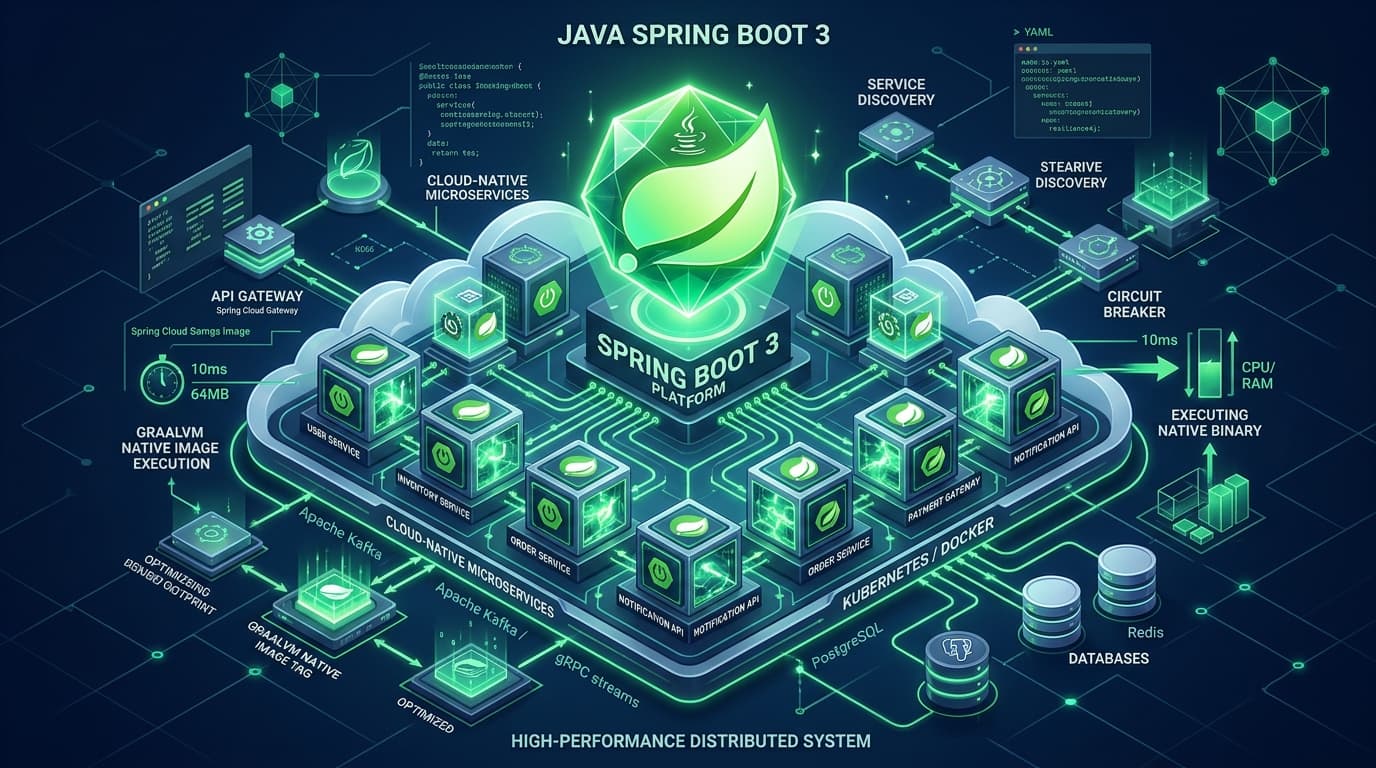
What You Must Master to Clear This Track
- Understand Spring Boot 3's baseline requirement of Java 17+ and Spring Framework 6 with Jakarta EE 10.
- Leverage Project Loom Virtual Threads via spring.threads.virtual.enabled=true for high-concurrency blocking I/O.
- Differentiate between JIT JVM compilation and GraalVM AOT native image generation for sub-100ms startup times.
- Use Micrometer Observation API with OpenTelemetry for unified metrics, logs, and distributed trace context.
- Design resilient microservices using Resilience4j CircuitBreaker, RateLimiter, and Retry annotations.
Step-by-Step Study Plan
Follow this sequential roadmap designed to take you from core foundations to advanced architecture and mock interviews.
Modern Core Fundamentals
Migration from javax to jakarta namespace, Record patterns, Pattern matching for switch, and virtual thread concurrency.
- •Migrate existing dependencies to Jakarta EE 10 (JPA, Validation, Servlet API).
- •Benchmark Tomcat thread-pool throughput vs Virtual Thread executor under high load.
- •Configure declarative HTTP interfaces using @HttpExchange instead of RestTemplate.
- •Enable virtual threads in Spring Boot 3.2+ with a single application property.
- •Profile thread state to verify virtual threads do not get pinned by synchronized blocks.
Resilience4j & Micrometer Tracing
Circuit Breakers, bulkheads, rate limiters, Prometheus metrics, and distributed tracing with Zipkin / Jaeger.
- •Configure CircuitBreaker state transitions: CLOSED -> OPEN -> HALF-OPEN.
- •Implement fallback methods adhering to strict method signature parity.
- •Instrument REST endpoints with Micrometer @Observed annotations.
- •Set slidingWindowType to COUNT_BASED or TIME_BASED based on traffic volume.
- •Verify traceparent headers propagate seamlessly across RestClient and Kafka producers.
AOT Compilation & Container Optimization
Ahead-of-Time compilation with Spring AOT engine, GraalVM native build tools, and Kubernetes health probes.
- •Generate GraalVM native binary using Cloud Native Buildpacks (paketo).
- •Register runtime hints for reflection and serialization using RuntimeHintsRegistrar.
- •Configure Kubernetes liveness and readiness state with Spring Boot Actuator.
- •Benchmark cold start times: compare JVM startup (~4.5s) to Native Image (~0.08s).
- •Verify memory footprint drops from 350MB RSS to ~45MB RSS in containerized tests.
1. Virtual Threads (Project Loom) in Spring Boot 3
Virtual threads decouple Java threads from OS kernel threads, allowing applications to spawn millions of concurrent lightweight threads without running out of memory.
Virtual threads mount onto carrier OS threads during CPU execution and unmount automatically during blocking I/O operations (database queries, HTTP calls).
Provides the high-throughput benefits of reactive programming (WebFlux) while writing simple, readable, synchronous imperative code.
# application.properties (Spring Boot 3.2+)
spring.threads.virtual.enabled=true

// Java Configuration for custom TaskExecutors
@Configuration
public class ThreadConfig {
  @Bean
  public AsyncTaskExecutor applicationTaskExecutor() {
    return new TaskExecutorAdapter(Executors.newVirtualThreadPerTaskExecutor());
  }
}- Avoid using synchronized blocks around long blocking operations, as this causes carrier thread pinning; replace them with ReentrantLock.
- Do not pool virtual threads with fixed thread pools; simply spawn new virtual threads per task as they are cheap to create.
2. Production Fault Tolerance with Resilience4j
In microservices, downstream failures can cascade and exhaust thread pools. Resilience4j provides lightweight, annotation-driven fault tolerance.
Transitions from CLOSED to OPEN when the error rate exceeds the configured threshold, immediately failing fast and saving downstream services.
Directs failed calls to a local fallback method that returns cached data or default responses without throwing user-facing 500 errors.
@Service
public class PaymentServiceClient {

  @CircuitBreaker(name = "paymentService", fallbackMethod = "paymentFallback")
  @Retry(name = "paymentService")
  public PaymentResponse processPayment(PaymentRequest request) {
    return restClient.post()
      .uri("/api/v1/charge")
      .body(request)
      .retrieve()
      .body(PaymentResponse.class);
  }

  // Fallback must match original method parameters + Throwable
  public PaymentResponse paymentFallback(PaymentRequest request, Throwable ex) {
    log.warn("Payment service unavailable, queuing for offline reconciliation: {}", ex.getMessage());
    return PaymentResponse.queued(request.getTransactionId());
  }
}Top Must-Know Interview Questions & Model Answers
Q1: How do Virtual Threads differ from traditional Platform Threads in Java?
- •Platform Threads: Heavyweight, expensive to create (~1ms), limited to a few thousand per JVM process due to OS memory and context switching limits.
- •Virtual Threads: Extremely lightweight, can instantiate millions simultaneously, managed entirely by JVM ForkJoinPool carrier threads.
- •Blocking Behavior: When a virtual thread blocks on socket I/O, the JVM unmounts it from the carrier thread, allowing other virtual threads to execute.
Q2: What is Ahead-of-Time (AOT) compilation in Spring Boot 3 and how does GraalVM utilize it?
- •Traditional JVM starts with bytecode, interprets it, and uses JIT (C1/C2 compilers) at runtime to optimize hot methods.
- •GraalVM Native Image performs closed-world analysis at compile time, eliminating dead code and compiling directly to machine code.
- •Benefits: Instant startup (sub-100ms) and minimal memory footprint, making it ideal for serverless lambdas and Kubernetes autoscaling.
Recommended Practice Quizzes on QuizCluster
Test your retention and prepare for timed live coding and MCQ technical screening rounds:
Java Core & OOP Internals Quiz
Test memory layout, garbage collection algorithms, JVM execution model, and concurrency primitives.
Microservices Architecture Quiz
Test Saga pattern, distributed tracing, API gateways, service discovery, and database per service.
Frequently Asked Questions
Can I use Project Loom Virtual Threads with Spring WebFlux?
You can, but it is generally unnecessary. Virtual threads are designed to give synchronous, blocking Spring MVC code the scalability of reactive programming without the complexity of Mono and Flux reactive chains.
Why does my GraalVM native image build fail when using certain third-party libraries?
GraalVM requires explicit reflection and dynamic proxy registration for anything not discovered during compile-time closed-world analysis. You must register RuntimeHints or use the GraalVM tracing agent to generate reflect-config.json files.