How to Prepare for SDE Interview: Complete 2026 Roadmap
From Algorithmic Patterns to System Architecture & STAR Behavioral Mastery
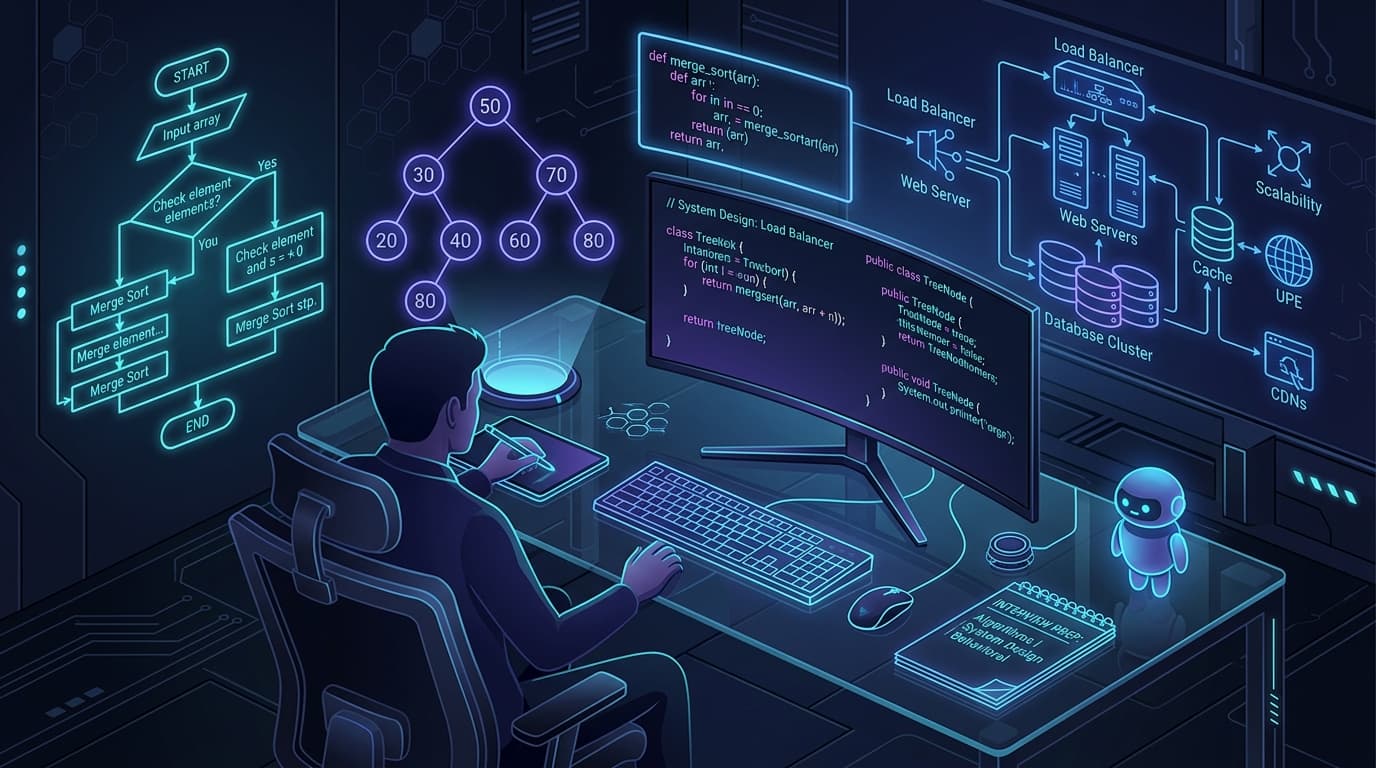
What You Must Master to Clear This Track
- Master the 14 core algorithmic patterns rather than blindly solving 500+ random LeetCode questions.
- Structure your System Design answers using the 4-step framework: Scope -> High-Level -> Deep-Dive -> Bottlenecks.
- Understand concurrency primitives, locks, mutexes, thread pools, and memory consistency models.
- Craft at least 6 STAR behavioral stories tailored to leadership principles, conflict resolution, and technical setbacks.
- Practice vocalizing your thought process before writing a single line of code in live coding rounds.
Step-by-Step Study Plan
Follow this sequential roadmap designed to take you from core foundations to advanced architecture and mock interviews.
Algorithmic Pattern Mastery
Focus on Two-Pointers, Sliding Window, Fast & Slow Pointers, Monotonic Stacks, and Tree Traversals (BFS/DFS).
- •Solve 3-5 pattern problems daily with strict 25-minute timers.
- •Implement Binary Search, QuickSort, and Min-Heap from scratch.
- •Master recursive backtrack state spaces and memoization tables.
- •Do not look at solutions for at least 20 minutes.
- •Write clean modular code with descriptive variable names.
- •Analyze Big-O Time & Auxiliary Space for every solution.
Graphs, Dynamic Programming & Object-Oriented LLD
Dijkstra, Topological Sort, 0/1 Knapsack, Longest Common Subsequence, and SOLID design patterns with UML diagrams.
- •Implement Graph algorithms: Cycle Detection, Disjoint Set Union (DSU), Kahn's BFS.
- •Design real-world OOP systems: Parking Lot, Movie Ticket Booking, Rate Limiter.
- •Practice applying Factory, Strategy, Observer, and Decorator design patterns.
- •Diagram class hierarchies with clear interface boundaries.
- •Ensure high cohesion and loose coupling in low-level design.
Scalability, Distributed Trade-offs & Bar Raiser Rounds
Microservices vs Monoliths, Caching strategies, Database Sharding, Message Queues (Kafka), and STAR storytelling.
- •Complete 10 core HLD architectures (URL Shortener, Uber/Ride Sharing, WhatsApp/Chat, Distributed Cache).
- •Draft 8 structured STAR behavioral anecdotes highlighting ownership and resolution.
- •Conduct at least 6 peer mock interviews under real interview conditions.
- •Always calculate back-of-the-envelope RPS, bandwidth, and storage capacity first.
- •Proactively discuss single points of failure (SPOF) and disaster recovery.
1. Understanding the Modern SDE Interview Funnel
Tech recruiting in 2026 relies on a structured, multi-stage assessment funnel designed to evaluate coding rigor, architectural maturity, and team culture alignment.
60-90 minute timed automated test with 2-3 medium/hard coding problems and unit test edge cases.
45-60 minute 1:1 round assessing problem exploration, clarifying questions, algorithmic optimization, and bug-free code.
Building scalable distributed systems (HLD) or clean maintainable class hierarchies (LLD) under real-world constraints.
Deep dive into past project complexity, conflict resolution, ownership, engineering trade-offs, and company culture fit.
- Treat the interviewer as a collaborator, not an examiner. Validate requirements before touching code.
- Always state assumptions out loud (e.g. 'Can array elements be negative?', 'Is the data stream infinite?').
- Jumping straight into coding without dry-running on an example input.
- Ignoring space complexity when creating auxiliary hash tables or recursive call stacks.
2. The 14 Algorithmic Patterns That Crack 90% of Coding Rounds
Rather than memorizing isolated problems, train your brain to identify the underlying pattern signature within 60 seconds of reading the problem statement.
Used for contiguous subarrays or subsegments with maximum/minimum/target conditions (e.g., Longest Substring Without Repeating Characters).
Used on sorted arrays for target sums, palindrome checks, trap rainwater calculations, and partition operations.
Detecting cycles in linked lists, finding middle nodes, and circular array loops with O(1) space.
Finding Next Greater Element, Daily Temperatures, Largest Rectangle in Histogram, and Sliding Window Maximum.
Dependency resolution, Course Schedule I/II, task build orders, and cycle detection in DAGs.
Identify subproblems: 1D arrays (House Robber), 2D grids (Unique Paths), Knapsack (Coin Change), and Interval DP.
// Universal Sliding Window Skeleton for Target Condition
function minSubArrayLen(target: number, nums: number[]): number {
  let left = 0;
  let currentWindowSum = 0;
  let minLength = Infinity;

  for (let right = 0; right < nums.length; right++) {
    currentWindowSum += nums[right]; // Expand window

    // Shrink window while condition holds
    while (currentWindowSum >= target) {
      minLength = Math.min(minLength, right - left + 1);
      currentWindowSum -= nums[left]; // Evict leftmost
      left++;
    }
  }

  return minLength === Infinity ? 0 : minLength;
}3. The 4-Step System Design Interview Framework (HLD)
System design interviews test ambiguity management and engineering trade-offs. Use this systematic 45-minute breakdown to maintain control.
Define Functional requirements (Core user actions) & Non-Functional requirements (Latency < 50ms, 99.99% Availability, Scale 50M DAU, Read-to-Write ratio 100:1).
Estimate RPS, network throughput, storage per year, and draw the high-level block diagram: Client -> CDN -> Load Balancer -> Web Servers -> Cache -> DB.
Choose Relational vs NoSQL, Indexing strategy, Sharding keys, Partitioning logic, Caching policies (Cache-Aside, Write-Through), and Message Queues.
Address Single Points of Failure (SPOF), Circuit Breakers, Rate Limiting, Replication lag, Distributed Transactions, and Monitoring.
End-to-end request lifecycle through caching, load balancers, and asynchronous queues.
4. Behavioral & Leadership: The STAR Storytelling Method
Senior engineers are judged heavily on communication, cross-functional conflict management, and ownership. Prepare 6 distinct stories in STAR format.
Set the context in 2-3 sentences: company, team size, core business challenge, and timeline constraints.
Explicitly outline your specific personal responsibility and what made the problem difficult.
Detail the specific technical and interpersonal actions YOU took (avoid using 'we'; highlight your personal decisions and trade-offs).
Quantify the outcome with business metrics (e.g. 'Reduced p99 latency by 42%', 'Decreased AWS cloud spend by $120k/year').
- Prepare stories covering: (1) A time you disagreed with senior leadership, (2) A production outage you caused or debugged, (3) Delivering under tight deadlines, (4) Mentoring a junior engineer.
Top Must-Know Interview Questions & Model Answers
Q1: How do you choose between SQL (RDBMS) and NoSQL (Document/Key-Value) for a high-throughput system?
- •Choose SQL (PostgreSQL, MySQL) when you require complex relational JOINs, strict ACID transactions (banking/payments), and well-structured normalized schemas.
- •Choose NoSQL (DynamoDB, Cassandra, MongoDB) for massive write scale, flexible evolving schemas, horizontal partition-key querying, and high availability over strong consistency.
Q2: What is the difference between Process and Thread, and how does Context Switching impact CPU overhead?
- •Process context switches require invalidating the Translation Lookaside Buffer (TLB) and switching page tables, incurring heavy cache misses.
- •Thread context switches only save/restore CPU registers, program counter, and stack pointer, making them significantly faster than process switches.
Q3: Explain the Trapping Rainwater problem and why Two-Pointers is optimal over Dynamic Programming.
- •DP approach computes prefix max and suffix max arrays, taking O(N) time and O(N) space.
- •Two-pointer approach moves the pointer with the smaller boundary inward, guaranteeing that the opposite boundary is at least as tall.
Recommended Practice Quizzes on QuizCluster
Test your retention and prepare for timed live coding and MCQ technical screening rounds:
Arrays, Two-Pointers & Sliding Window
Test pointer arithmetic, window expansion, and boundary validations.
High-Level System Design (HLD)
Practice load balancing, sharding, caching, and rate limiting MCQs.
OS, Concurrency & Thread Safety
Master locks, semaphores, deadlocks, and virtual memory questions.
Frequently Asked Questions
How many LeetCode questions should I solve to be interview-ready?
Quality beats quantity. Solving 120-150 well-categorized pattern problems (Blind 75 / NeetCode 150) with deep understanding is vastly superior to doing 500 problems with memorized solutions.
Should I write in Python, Java, or C++ during coding interviews?
Use the language you are fastest and most expressive in. Python is popular for DSA due to concise syntax, while Java and C++ are great for showing strong OOP principles and type safety.